

Reign of the devourer, p.1
Reign of the Devourer, page 1
part #4 of Marvel Untold Series


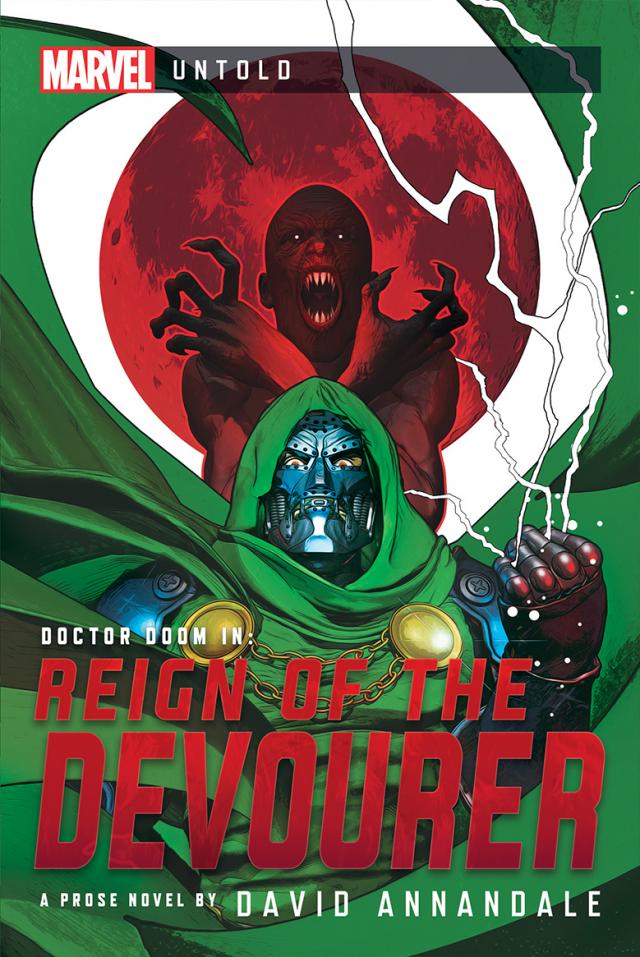
Reign of the Devourer
Doom towered over Zargo, a shape stronger and more terrible than the mountains.
“Tell me what is here,” said Doom.
“There are human memories here. And ones that are older. It keeps memories, and it… it consumes them.”
“Where?” Doom asked. He leaned forward, eyes blazing behind the mask.
“Beneath us. Far beneath us. I think you should leave it alone,” said Zargo. “It’s dangerous.”
Doom said nothing at first. His still presence, so powerful it filled the space between the mountains, invited Zargo to decide which was more dangerous, Doom or the call from below. Then Doom said, simply, “It will be mine.”
Zargo understood that there wasn’t a choice of danger. It was the collision of wills between Doom and the hunger beneath that he should fear.
FOR MARVEL PUBLISHING
VP Production & Special Projects: Jeff Youngquist
Associate Editors, Special Projects: Caitlin O’Connell and Sarah Singer
Manager, Licensed Publishing: Jeremy West
VP, Licensed Publishing: Sven Larsen
SVP Print, Sales & Marketing: David Gabriel
Editor in Chief: C B Cebulski
Special thanks to Tom Brevoort
Doctor Doom created by Stan Lee & Jack Kirby
© 2022 MARVEL
First published by Aconyte Books in 2022
ISBN 978 1 83908 094 4
Ebook ISBN 978 1 83908 095 1
All rights reserved. The Aconyte name and logo and the Asmodee Entertainment name and logo are registered or unregistered trademarks of Asmodee Entertainment Limited.
This novel is entirely a work of fiction. Names, characters, places, and incidents are the products of the author’s imagination or are used fictitiously. Any resemblance to actual events, locales, organizations or persons, living or dead, is entirely coincidental.
No part of this publication may be reproduced, stored in a retrieval system, or transmitted, in any form or by any means, electronic, mechanical, photocopying, recording or otherwise, without the prior permission of the publishers.
This book is sold subject to the condition that it shall not, by way of trade or otherwise, be lent, re-sold, hired out or otherwise circulated without the publisher’s prior consent in any form of binding or cover other than that in which it is published and without a similar condition including this condition being imposed on the subsequent purchaser.
Cover art by Fabio Listrani
Distributed in North America by Simon & Schuster Inc, New York, USA
ACONYTE BOOKS
An imprint of Asmodee Entertainment Ltd
Mercury House, Shipstones Business Centre
North Gate, Nottingham NG7 7FN, UK
aconytebooks.com // twitter.com/aconytebooks
For Margaux, always. For all that we have, and for what is to come.
Prologue
By such dread words from Earth to Heaven
My still realm was never riven:
When its wound was closed, there stood
Darkness o’er the day like blood.
Percy Shelley, Prometheus Unbound, I.99–102
They were here because of the scars. Doom knew that was why he had come. He wondered whether Grigori Zargo knew what had drawn him here as well.
Standing on the peak of a jagged claw of hardened lava over fifty feet high, Doom watched the priest move like a crawling insect over the tortured land. North of Doomstadt, and south of the Kanof Valley Dam, the dried lake bed had been wounded again and again over the course of the last year. The land here had the misfortune to be crossed by multiple ley lines. Where a node had formed, Doom had constructed an arena for his Midsummer duel against a champion of Hell. The duel had shattered the crust of the Earth. The molten blood of the plain had run incandescent red. And then, when Zargo had done as Doom commanded, and raised the lodestones that had been created by the agony of the ley lines, the land had bled again, had burned with the touch of Hell seeking a clawhold in the world.
The face of the plain had suffered greatly. It was scarred. Long ridges of black rock, like the spines of fossilized leviathans, crisscrossed the baked, glassed lake bed. They were the maps of the injuries. Where the blood had erupted most violently, the formations were congealed pain, shrieks of lava raising their twisted points to the sky.
The wind keened over the ruined land. The summer had been a cool one. On Walpurgis Night, April 30, Doom had activated the Harrower, the engine born of science and sorcery that he had created to pull his mother’s soul from Hell. His mother, who had only ever sought to protect her people from King Vladimir, and whose good intentions had been used and twisted by Mephisto to trap her in Hell. Every Midsummer, Doom fought Mephisto or his choice of champion to free her. Every Midsummer, Doom lost the duel, its terms always predetermining its end. On Walpurgis Night, he sent the power of the Harrower into Hell instead. But the rebel Fortunov had sabotaged the machine, and the Harrower had unleashed a plague of demons on the city. Doom had destroyed the monster the Harrower became, and stopped the plague, but there had been a price to pay. He had come to the plain because of the personal cost he had suffered. His subjects had paid too. In the wake of the demons had come the rain of ash. It had spread far beyond Doomstadt to cover all of Latveria, as if the city had been the center of a massive volcanic eruption. The ash had fallen slowly, covering the sky and the ground for weeks. Even after the worst had passed, it was as if the sun had been shackled, unable to bring its full strength. So summer had passed, subdued and sullen.
The Midsummer duel had come and gone, and he had lost again, to the howling mockery of Hell.
Now it was September, and fall was as eager to make its presence felt as summer had been reluctant. The winds were stronger and more piercing than usual. Here and there, ash still fell instead of rain. The dried lake bed was one such place. The ash fell more often here than anywhere else. Eddies of black whirled, caught in a mournful dance with the wind. The air was gray, the entire region of the duel shrouded in limbo.
Gray wind and black scars, Doom thought. That is the fruit of my labors.
The landscape spoke to him of what he had lost. It was the image of the price he had paid. In his struggle against the Harrower, there had been a revelation, and then it had been taken away from him. All he could remember was that he had forgotten, and that what was forgotten was beyond price.
Gray wind and black scars. It does not end like this. I will not permit it.
Below, Zargo walked aimlessly, moving from ridge to ridge. The priest spent most of his days here, Doom knew. The days that he did not, were spent sequestered in the rooms he had taken in Old Town, in the near shadow of Castle Doom. Zargo had not returned to St Peter Church, whose vicar he had once been, since its destruction. He had not even gone to see the progress of the reconstruction. The church would be restored to everything it had been. Doom would not permit scars to deface Doomstadt.
He had fled the sight of his church, but Zargo could not stay away from here. Doom wondered if Zargo understood what was drawing him to the lake bed. Perhaps he did. Whether Zargo grasped the idea or not, this was a place where he belonged. This was where he had first truly flexed his powers as a geomancer. The scars of the land were part of Zargo’s history. His actions had helped to create them.
The wind blew harder, billowing Doom’s cloak. He looked away from Zargo and let his eyes trace the lava scars. Their shape was a memory in the most profound sense. The land remembered its pain, and showed it. What was here could not easily be erased. There was no forgetfulness here. That was important.
Scars could not be forgotten, Doom thought. They were the sign that there is no true healing.
No healing, no forgetting, no forgiving. Not when there were scars.
The scars on the land angered him. This portion of Latveria had been defaced, and to no end. The demons had killed hundreds in Doomstadt, and Doom’s mother was still in Hell.
These were the marks of his failed work. They were the marks of the debt owed by those who made it fail.
Doom thought about Fortunov. He let anger wash over and through him in a molten wave.
Then he calmed himself. Scars were a goad, too. They drove him to greatness.
These scars would have their use. They would take him to power.
•••
Zargo felt the gaze of Doom. It weighed on him, heavy as stone, and it bore through him, sharp as ice. He stopped walking again, exhausted by its strength, and stared numbly at the broken textures of the lava ridge he stood upon.
Why was Doom here? Zargo couldn’t be of interest to him any longer.
Except, somehow, he was.
I did what he commanded. Because I obeyed, I helped unleash Hell. Because I obeyed, my church fell.
He didn’t think he could ever go back to St Peter. He couldn’t look at the construction site. He had gone by once, just once, and he had been unable to see the rising of a phoenix. He had only seen the evidence of destruction. His eyes had looked to where the towers should have been, and seen only absence in the sky. When the work was finished, he would not see the church whole again. He would see a simulacrum, a monument to his sin.
The ruined lake bed was another such monument, but at l east it didn’t look like the thing he should have saved. So his guilt brought him here instead, like a tongue drawn to the gap of a newly missing tooth. He found no comfort when he walked on the broken surfaces of the ridges. He found still less on days like this, when the wind blew hard and when the ash stung his eyes and throat. On days like this, the world beyond the lake bed vanished. The hills to the east and west were shapeless masses, a thicker darkness embracing the gray, slowly converging to the north. To the south, there was nothing, just the slow fall of ash erasing the horizon. Surrounded by pain, he became part of it. His breathing, gnawed by guilt, was heavy and rasping.
He was no good to anyone, and most certainly not to his flock. Their shepherd was absent, and that was another sharp fang of guilt, but he couldn’t face them. Not yet. Perhaps not ever. He had lost all the certainty and peace he had known in the Nigerian seminary that had trained him and given him everything good about the priest he had believed he should be. The priest was gone, brought low because it was only as a geomancer that he had been able to protect his parishioners from demons. He needed to be alone, and so he came here, to wander the twisted lines, to indulge in a pilgrimage with no purpose or destination, and in a meditation without peace.
Now Doom had come. When Zargo saw the silhouette on top of the one of the tallest of the lava formations, he looked away, momentarily gripped by the delirious thought that he could pretend Doom was not there. He tried to walk on. Maybe he could go so far that he would not be able to see this formation.
The gaze held him. It stole his strength, and what sense of purpose he still had. He walked without seeing where he went, directionless. A new fear gripped him, a fear of what might come, and it wrapped its talons more and more firmly around his chest. Finally, it immobilized him. He stayed where he was, head down, vision glazed by gray, and waited for the inevitable.
Zargo did not hear Doom descend from the peak. He did not hear the thrust of Doom’s waist-mounted jetpacks. All he heard was the crunch of stone beneath heavy boots. That was the sound of fate coming for him again. It made him turn around.
Zargo looked up. Ash fell around Doom, dancing around him as if it feared him. Inside the dark green of his hood and cloak, the gray of his armor was stronger than the gray about them. He was the shape of will, and that was a terrifying thought to Zargo. If Zargo was partly responsible for the pain of the land, he had also been just the tool of force too strong to resist, too great for Zargo ever to fully comprehend. Doom’s will had directed him. Doom’s will had been the engine of everything that had happened. There had been catastrophe, and it was Doom’s will that had ended that too. Everywhere Zargo looked, he saw the physical traces of Doom’s will.
“I have nothing left to give you,” Zargo said. Despair gave birth to what was almost defiance. “What more do you want? You have broken my faith and my church.”
“Your church?” Doom asked. The metallic voice was deep. Its rasp harsh as a prison.
Zargo said nothing. There were answers to the presumption in Doom’s question. Zargo didn’t have the strength to give voice to any of them.
“St Peter is being rebuilt,” Doom said, his tone knowing. He paused long enough for Zargo to squirm in the guilt of his silence. “You could be ministering to your flock even now. Yet you are here instead.”
“I am not worthy to be their priest.”
“That is your choice. I am unaware of any edict declaring your unfitness.” Doom shrugged. “The state of your faith if no concern of mine, nor do I find it remotely interesting.”
“Why do you torment me?” Zargo pleaded.
“The torment is your choice to experience,” said Doom. “Wallow in it, if that is your wish. I am here because you are my subject, and you are of use to me. Your powers are, that is.”
“You are speaking to the geomancer once more,” Zargo said dully.
“I always have. That you have split the geomancer from the priest is, again, your choice. As a way to suffer, it is so unnecessary that it borders on bad comedy, but that too is not my concern. Your obedience is.”
Zargo tried to meet Doom’s gaze. He couldn’t. The eyes looking down at him were harder than the titanium mask. “How can I serve?” he asked. There had never been a question of choice.
“You will serve me by doing what you have come here to do. You are here because the land holds memories, and you can feel them.”
“Anyone can. All they have to do is look or touch.”
“Your sense of the memories is far more profound.” Doom stretched his arm to take in the landscape, his fingers wide as if to grasp hold of it. “You think about what you did to create these scars. You think, too, that they are the expression of my will.”
Zargo felt the blood rush from his face. He couldn’t swallow. How can he know?
Because he was Doom.
“Will affects reality,” said Doom. “The mind is energy. If this is so, the memories are energy too, and cannot be destroyed.” Doom made a fist, as if pulling something up from the ground. “You will assist me in finding what is lost but not destroyed. You will unearth memories. Literally.”
“What memories?” Zargo asked, wary of the answer, frightened of what he might have to do, and resigned to the knowledge that he could not disobey.
“All of them,” said Doom. “And the power they contain.”
The wind gusted against Zargo, shrieking with premonition.
Part 1
The Vaults of Remembrance
I heard
Thy curse, the which, if thou rememberest not,
Yet my innumerable seas and streams,
Mountains, and caves, and winds, and yon wide air,
And the inarticulate people of the dead,
Preserve, a treasured spell.
Percy Shelley, Prometheus Unbound, I.179–184
One
They gathered in the ruins of a fortified house. It was in a pass of the Malhela mountains, close to the border between Latveria and Symkaria. The pass was rarely used. It was too narrow, steep and crooked for any route for vehicles to have been built along its ancient path. On foot, it was treacherous, and too dangerous to be traveled at night. Crevasses cut across it, and there were long stretches where the path was an uneven ledge only a couple of feet wide.
There must have been a time, Rudolfo Fortunov thought, when the pass had seen more use. The house was evidence of that. Perhaps this route between the nations hadn’t always been so forbidding. When the change had come, though, it had come long ago. The house had been disused for centuries. It was a boxy thing, almost a keep. Its roof had fallen in, and the upper portions of the walls were breaking down, as if chewed by giants. Mortar crumbled out from the heavy slabs of its masonry. Inside, it was hollowed out. There were no longer any divisions between the rooms. The house was a shell.
It was altogether too fitting a place for this gathering.
There were twenty of his partisans with him, and that number was close to being the sum total of the forces he still commanded. He had lost so many in the failed coup, and still more when the demons had come to Doomstadt. He had fled Doom’s anger, and hidden for months in the wilderness. So had his followers, though still more had abandoned the cause. After the disasters, too many no longer believed the Fortunovs could ever be returned to the throne. Those who still believed, the ones with true iron in their souls, were, like him, ragged, hungry and exhausted.
“So you’re abandoning the field, then,” said Maleva Krogh. “You are running away.”
“We are retreating,” Fortunov told her. “That is not the same thing as flight.”
“Is that what you tell yourself?”
Fortunov’s jaw clenched. He fought with his temper and kept it down. He was too drained to rage anyway. But this was why he had always kept Krogh at arm’s length, even though no one was more committed to the overthrow of Doom than she was. Her family was one of the oldest in Latveria, older even than the Fortunovs. Though the Kroghs had never ruled the country, they had been so integral to the old order, they might have been its spine.






