

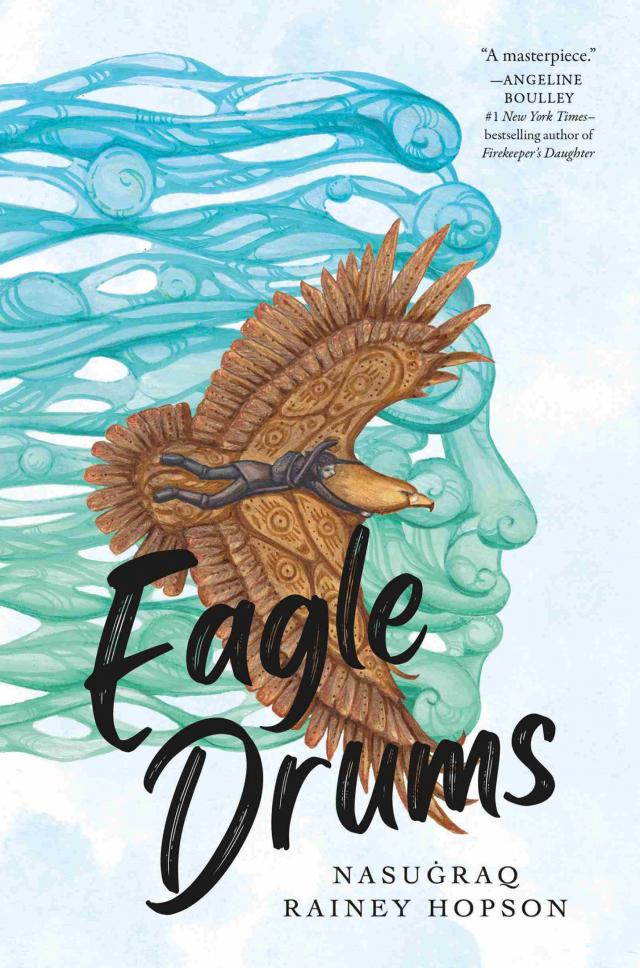
Eagle drums, p.1
Eagle Drums, page 1


Begin Reading
Table of Contents
About the Author
Copyright Page
Thank you for buying this
Roaring Brook Press ebook.
To receive special offers, bonus content,
and info on new releases and other great reads,
sign up for our newsletters.
Or visit us online at
us.macmillan.com/newslettersignup
For email updates on the author, click here.
The author and publisher have provided this e-book to you for your personal use only. You may not make this e-book publicly available in any way. Copyright infringement is against the law. If you believe the copy of this e-book you are reading infringes on the author’s copyright, please notify the publisher at: us.macmillanusa.com/piracy.
For Taktuk and Kanaaq, my Sunshine
Aaka loves you always and forever
1
BROTHER
Sweat trickled down his back. He ignored it. A mosquito hummed in his ear; he ignored that, too. His body ached from being still so long; his feet were going numb again. Slowly, Piŋa flexed his toes to get the blood flowing. A little longer, he told his body, even though he had been waiting more than four hours already. His heavy-lidded eyes gazed straight ahead, focused on the movement of grass, the shifting of wind. His body moved only when the grass did, so slowly did he creep up on his prey.
The largest bull caribou gave a snort. With a sigh, the bull dropped down in the tall tundra grass, his ears twitching. Several other caribou took the bull’s signal and settled down, relaxing their guard. Piŋa took note of which caribou were left standing, acting as sentinels for the herd, and crept forward again, slowly pulling his bow out and placing it in front of him. It had taken most of the day to get this close; he was determined not to let this chance slip away.
With a practiced movement, the boy nocked an arrow in his bow, pulled back, and released. It was timed, swift and sure, with the exhalation of the largest bull.
The arrow struck the bull with a soft thump. Quietly, as though falling into sleep, the great antlered head lowered itself to the tundra. The bull made no other sound and lay still.
Methodically, the boy shot the other resting caribou, one after the other, with the same silent, deadly accuracy. When the last sitting caribou died, it let out a soft mewling noise, alerting the herd. Nervously, the others hurried away.
The boy straightened from his crouch and stood, stretching his cramped muscles. He walked over to the largest bull and ran his hand slowly over the tips of the antlers. They were almost as tall as the boy. A quiet smile softened his face.
Carefully, the boy set the bull’s head so it faced the boy’s home to the west. He bent down and whispered in the bull’s velvet ear, telling the bull how to find him. He opened the bull’s still-warm mouth and placed a pinch of lichen on the tongue, then he took his sharpest obsidian knife and severed the third vertebra, releasing the bull’s earthbound spirit to be born again. He did this for each of the fallen caribou. These small gifts ensured that he would be remembered as a kind and unashamed hunter, and next time their spirits would recognize him.
The boy had caught twelve caribou. His mother and father would be proud. When he had finished honoring their lives, he began the task of butchering.
With years of experience guiding his hands, his knife found all of the familiar spots to slice and cut and pry, and soon the animals were quartered expertly, wrapped in their own skins to keep the meat clean of tundra debris. Later he would bury the bundles in rocks to keep them cool and prevent animals from getting to them. He carefully examined the meat and the organs as he worked, using all of his senses to look for signs of disease that would make the animal unfit for eating. One animal showed signs of having been attacked by a bear recently, and a couple of the wounds were not healing right. He could see the sickness spreading from the wound into other parts of the animal. He set that one to the side, making sure it did not touch the others. It would be fed to the dogs so it would not go to waste. The meat would not hurt the dogs, as their stomachs were much more robust.
The layer of fat on the largest bull’s back was a finger length deep, showing how healthy and well-fed the animals were.
Piŋa could measure the season and age of the animal by the width of the fat and where it accumulated on the body. He could see how time manipulated the bodies of the caribou, like the length of daylight. Every animal was bound by these changes in their bodies as the moons turned and seasons passed.
That night, the boy lay down on his mat under the cooling light of a stubborn sun. Thoughts, like panicked ground squirrels, scurried through his mind. He ran his fingers lightly along his bow, watching how the smooth wood gleamed in the light, pearlescent with the years of use. It had belonged to his two brothers; each one had carried it before him.
His oldest brother, Atau, had crafted it by hand. The boy had heard stories of how it had taken years to find the perfect piece of wood, with the right height, heft, and suppleness. His brother had chosen well. The sinew had to be changed often, but the wood itself never discolored or cracked. When Atau had disappeared long ago into the mountains, all that his parents found was his bow.
The middle brother, Maliġu, had then used it and carved images into its length. The carefully designed etchings depicted a love of the mountains, a reverence for hunting, and land animals in various poses. Behind each animal were carvings of the place and time of year the animals could be found. The entire bow was a map of sorts, teaching the boy all he needed to grow skilled in the taking of animals. Many of the etchings were almost worn away, but the boy knew its lessons by heart. Maliġu had also disappeared into the mountains, leaving behind only the bow and no clue to his fate.
The boy grimaced. He knew that his mother, seeing all the caribou, would be ecstatic at first, but he knew also that grief would wrap itself around her joy like fall-time darkness. Any excitement she felt would be forgotten as she began to tell stories about his missing brothers. She would talk about Atau’s speed when quartering the caribou, his cuts clean and never hesitant, their skinned hides flawless and smooth, without any holes or thin areas. She would talk about Malġu’s strength, how he could carry a full-grown bull caribou for at least a mile, and how he would work tirelessly for days without complaint. She would go on about the amazing hunters they had been and how proud she was of their prowess.
The boy would sit there and nod as he always did, letting her list all the wonderful attributes his brothers had had. And at the end of her speech, she would look at him, fear clouding her soot-colored eyes, wondering if he, too, would one day disappear. He loved his mother greatly and hoped one day he would only see his own reflection in her eyes, and not the shining memories of his brothers.
His father would say very little, of course. He would just pat the boy briefly on his back, a wide smile on his dark face, and whisper, “Good job, son.”
At times, the boy thought his father took his brothers’ disappearance the hardest. His silence became something you could almost see, a depth and heaviness in the air. He often sat alone, eyes scanning the distant horizon toward the mountains, one calloused and rough thumb gently following the surface of a carved ivory goose that Mother had made. There was nothing more fiercely protective than a goose defending its offspring. He’d kept the carving tucked into the inner lining of his parka ever since his two older children had disappeared. Piŋa didn’t know what to make of his father’s grief, so he focused on just being the best son he could be.
How can you compete with someone’s memories, anyway?
A jaeger beat its wings in the wind, drawing the boy back to the present. The bird was headed for his carefully stashed meat. Annoyed with himself for letting his mind wander, the boy threw a stick in the bird’s direction, letting it know that the meat belonged to another. When the bird had flown off, the boy rolled his body into tanned caribou hides and fell asleep to the sound of flapping wings and buzzing insects.
2
LEAVING
After making sure the meat was safely stored in temporary stone caches, he traveled home and grabbed the pack dogs, fashioned a travois from willow branches, and hauled all of his catch back with their help. Five days later, after two trips, the boy found himself examining a thin crack in the ice-covered wall of the sigluaq and wondering if he should shore up that part of the wall before the crack widened.
The siġḷuaq was built underground to preserve meat even when all the ice and snow had thawed above. Two feet beneath the earth lay a layer of ice that never melted, no matter the weather or season. The boy and his parents had spent weeks chipping away at the frozen layer till it was large enough to hold the winter season’s worth of food. Then they’d built a protective ceiling of wood and sod and whalebone above it. A ladder led up to an opening in the ceiling, which let in some light to see by. This storage mound was only a few years old, built to replace their previous storage space, which was much too large for just the three of them. It was still settling into the soil, so he was careful to inspect the walls whenever he was in there.
“You know, you should talk more, Piŋa,” his mother said. To make room for the caribou, she was stacking frozen seal pokes, one atop the other, in the underground storage. “Your brothers knew how to tell a good story; how else are we supposed to know about your hunting?”
He ignored her and continued to examine the wall, hoping his silence would deter her from more conversation. Sometimes her need
“If you told me about your hunting,” she continued undeterred, “maybe I could sew a bag showing off your great fight. Wouldn’t that be nice?”
In the semidarkness, the boy nodded in her direction. A long pause stretched out between them. He ran a finger over the crack and decided he wouldn’t need to worry about it for a few seasons more, as it was still shallow.
“Well?” she said. “Aren’t you going to say something?”
From her insistent tone, he knew he had to respond soon or he would be scolded.
He thought carefully about his mother’s question. Should I tell her the story of my numb feet? That would make an interesting bag design, he thought. But instead he said, “They died well.”
“Is that all you have to say?” She snorted softly, shaking her head. “Just like your father. Well, I can talk enough for the both of us, I guess. Hand me that other poke, would you?”
The boy and his mother maneuvered the already stored meat to make room for the fresh ones. They took care to make sure that the two did not touch—ocean on one side, land on the other, giving respect to both worlds. Soon enough, the underground larder was half-full.
* * *
Piŋa straightened and stretched the muscles between his shoulders as he finished distributing the allotted meat to his family’s pack dogs. They were quiet as they worked on their portions of caribou, with only the occasional low warning growl for others not to get too close.
He took a deep breath, filling his lungs as he walked back to the sod house. The air carried the scent of plants turning in the fall-time weather, heavy with notes of water and fog and vague, fleeting promises of snow. The day was overcast with heavy clouds, typical of the shift from summer to fall. He changed the direction he was walking when he caught the smell of a cooking fire and the enticing smell of a meal. He made his way around to the entrance tunnel to his family’s earthen home, to where the wind would be the least. The tunnel itself rose above the ground and was just shorter than he was.
His mother sat next to a small fire, and when she saw him, she waved him toward the shallow stone bowl that was perched on some coals. With the deft twist and turn of her hands, his mother tied her hair up in a quick braid and secured it with a slim ivory pick. She picked up her ulu, a wide, curved blade about the size of her palm, and drew it against a fine-grained rock a few times to sharpen its edge. The boy watched as she crossed her legs and silently began stretching and wetting the caribou skins to ready them for tanning. He smiled, realizing that the only time she was quiet was when she was concentrating on her skins. He crouched next to the fire and reached into the bowl for a piece of caribou meat. It steamed in the air, and hot fat dribbled down his sleeve. He took a bite; it was so soft and tender that it barely needed chewing, and it practically melted on his tongue.
From the direction of the beach, he could hear his father mumbling under his breath. He watched as his father worked in the distance, repairing a small tear on the skin of his kayak. His father hunted all that was of the ocean, and it showed in the darkness of his skin and the strength in his shoulders from days of paddling under the sun. He was the master of that domain—he knew the ocean better than any man before him. But he never chided the boy for loving the land instead of the sea, even though he’d lost two sons to it.
For eight turns of the moon, their hunting grounds were covered in snow and ice, which left only four brief, hectic cycles to gather as much food as they could for the coming winter. They’d always had food to last the long cold season and furs to protect them from the dangers of that season. His mother, a gifted seamstress, would make beautifully designed clothes, sewing hunting scenes into the hems of their parkas—ocean waves for his father and snowcapped mountains for the boy. Their kayaks were flawless, made of the strongest hides. Their sealskin and caribou-skin ropes never broke under pressure. Their knives maintained their finely honed edges, even after days of butchering.
In a land that could be dangerous and demanding, times were good for the boy and his family. They never took more than was needed, and they survived thanks to the animals and their kindness and generosity—and a heavy dose of luck. But the boy had no one else to compare his family to, for they rarely saw others, and when they did, they were cautious and kept their distance. The boy often wondered what those people thought when they saw his family. Did they want to take what his family had worked hard for? Were they planning how to push his family out of this rich territory? He remembered the camaraderie and the closeness he had had with his brothers, and he wondered what it would be like to get to know a stranger.
His parents rarely talked about how they had met. When they did mention it, it was always with carefully thought out words, as if they knew broaching the subject would stir up unanswered questions. He knew it was through a brief trade agreement between their fathers that ultimately had led to the two young people running away to be together, but Father refused to go into too much detail, instead waving his hands and commenting, “In this world, people have not found anything beyond being offended.”
His mother looked up from her work, almost as if she heard his wondering thoughts. “We need more obsidian for knapping, son,” she said quietly. “Your father is going to try for more fish down the coast before freeze-up. We can get one more batch dried and smoked and put into the siġḷuaq, so that means it will have to be you to go up into the mountains before it gets too cold.”
“I will leave tomorrow,” he replied. He took another bite of meat.
“You be careful,” she said, a note of worry creeping into her voice. “And don’t take longer than necessary.”
Her words stung. Didn’t she trust him yet? It had taken her two years to finally allow him to hike up to the mountains after his brothers disappeared. Despite her warnings that something up there would take him, just as it did his brothers, the boy had made many trips in the years since, and the only danger he had run into was a young male brown bear whose fur was now part of his parents’ bedding.
Nothing is more dangerous than a bear, he thought, but didn’t dare say out loud. He turned away from his mother and dug back into the bowl for another piece of meat.
When the boy finished eating, he stretched out his tall frame on the ground next to his mother and watched the rhythmic movement of her hands as she scraped the dried membrane from the skin. Soon his eyes drooped, and he fell into a half slumber. In his mind, he went through the trip he would make the next day. He relaxed, belly full, as he considered what equipment to take and which route would be quickest. He would pack his waterproof socks made from seal intestines and leave behind the heavy throwing spears his father would probably push. He planned to move fast and did not want to get slowed by boggy tundra or unwieldy weapons. Eventually the soothing familiar sound of his mother scraping the skin lulled him into an afternoon nap.
* * *
Early the next morning, his mother hovered around him as he packed for his trip to the mountains, and he tried his best not to frown at her in annoyance. He tucked his elbows closer to his body as he moved around the tight space inside the sod house, stuffing supplies into his bag. His father watched from the sleeping platform, legs crossed as he absentmindedly rolled up a long length of braided sinew he was packing for his own trip down the coast in the opposite direction. His father’s soft, deep voice rumbled under his mother’s hovering movements.
“You can take two of my throwing spears, iġñiin, if you want. Over there.” He gestured to the wall where a rack held their weapons. “Might help just in case. Better to have something rather than nothing when you need it.” The boy raised his eyebrows at his father’s suggestion. But he didn’t reach for them, and instead grabbed an extra bowstring and stuffed it into his pack.






